168 girls empowered with AI skills through Guyanese Girls Code Programme
Guyana Chronicle
14 June 2026
A TOTAL of 168 girls across four regions have been equipped with foundational Artificial Intelligence (AI) and digital skills through the Guyanese Girls Code Programme, an initiative of the Industry and Innovation Unit (IIU) within the Office of the Prime Minister.
The programme, which forms part of Guyana’s observance of International Girls in ICT Day, continues to encourage greater participation by girls in the field of technology while supporting the country’s broader digital transformation agenda.
According to the IIU, the Guyanese Girls Code Programme is a targeted digital skills and AI literacy initiative designed to provide women and girls with early exposure to emerging technologies.
Over the past five years, the programme has responded to the growing need for inclusive, future-ready education aligned with Guyana’s Science, Technology, Engineering and Mathematics (STEM) and digital transformation goals.
The final leg of the 2026 programme was held in Region Ten on Saturday, concluding this year’s observance.
This year’s programme was led by Miriam Jainarine, who has served as lead trainer for the past five years. Jainarine was previously a beneficiary of the Unit’s advanced training programmes and was also the second-place winner in the Unit’s 2024 Innovation Challenge (Hackathon).
Held under the global theme, “AI for Development: Girls Shaping the Digital Future,” the programme targeted girls between the ages of 13 and 15.
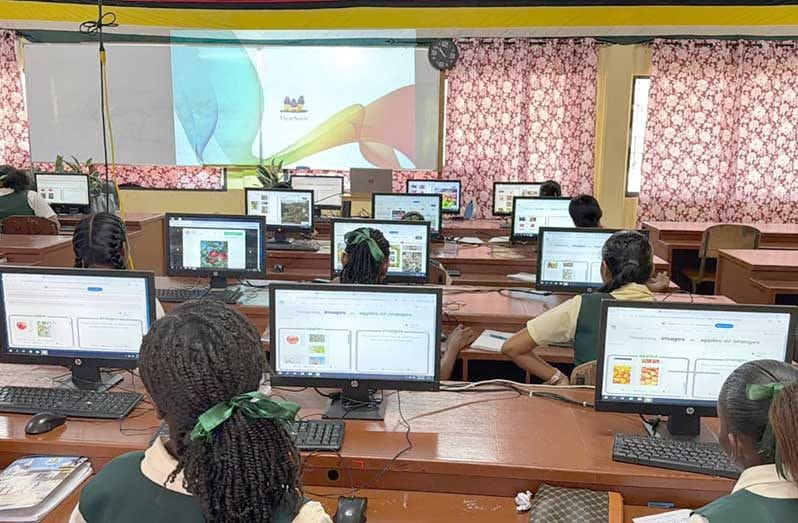
Participants were introduced to ethical AI principles and core AI concepts through relatable, real-world examples before progressing to hands-on exploration of how machines learn from data.
The six-hour, in-person, school-based training programme was delivered at Leonora Secondary School in Region Three; Annandale Secondary School in Region Four; Bush Lot Secondary and Bygeval Secondary schools in Region Five; and New Amsterdam Secondary and J.C. Chandisingh Secondary schools in Region Six.
According to the IIU, the training utilised a blended pedagogical approach that combined instructor-led teaching, inquiry-based learning, peer instruction, live demonstrations and collaborative project work.
The Unit noted that this year’s curriculum placed a strong emphasis on ethical awareness and design thinking.
Students were guided to identify real-world problems within their schools and communities, collaborate in groups and develop AI-based solutions through gamified activities and creative challenges.
Participants also explored machine learning fundamentals, compared human and machine intelligence and experimented with model behaviour through practical exercises.
The students built and tested both text-based and image-based AI models, identified errors and biases in outputs and integrated the models into Scratch-based projects using a use-modify-create approach.
The programme concluded with project presentations where participants showcased their AI applications, received peer feedback and reflected on the ethical implications of artificial intelligence.
According to Director of the Industry and Innovation Unit, Shahrukh Hussain, the Guyanese Girls Code Programme represents a strategic intervention aimed at bridging the gender gap in technology while equipping young women with essential skills for the future digital economy.
He explained that the programme is designed to address these challenges by demystifying AI and Machine Learning through accessible, creative and no-code learning approaches.
He underscored the rapid advancement of AI and machine learning globally and noted that providing young women with early access to these fields remains a priority for the Unit.
Hussain believes initiatives such as the Guyanese Girls Code Programme help break down barriers associated with limited exposure to technology, build confidence and encourage greater female participation in STEM-related fields through practical, hands-on learning experiences.


